
1933–1942 · Over 300 Types of Work
Work That Matters, Work That Lasts
The Lasting Legacy
Nine Years That Shaped America
In nine years of operation — 1933 to 1942 — the Civilian Conservation Corps accomplished more than any conservation program in American history, before or since. More than 3 million young men passed through its ranks. The CCC was responsible for over half of all reforestation, public and private, done in the nation's history up to that point. More than 300 types of work projects were completed across all 48 states, Hawaii, Alaska, Puerto Rico, and the Virgin Islands.
They planted 3 billion trees. They built or improved 800 state and national parks. They erected 3,470 fire lookout towers and laid 97,000 miles of fire roads through wilderness. They constructed 41,303 bridges and 125,000 miles of roads and truck trails. They treated erosion on 84,400,000 acres of agricultural land — an area equal to Ohio, Indiana, and Iowa combined. They built 4,105 fish-rearing pools and stocked 636.4 million young fish into American streams.
And they sent $663 million home to their families — the primary income, in many cases, for 12 to 15 million Americans. What they built in the forests endures. What they sent home saved lives.
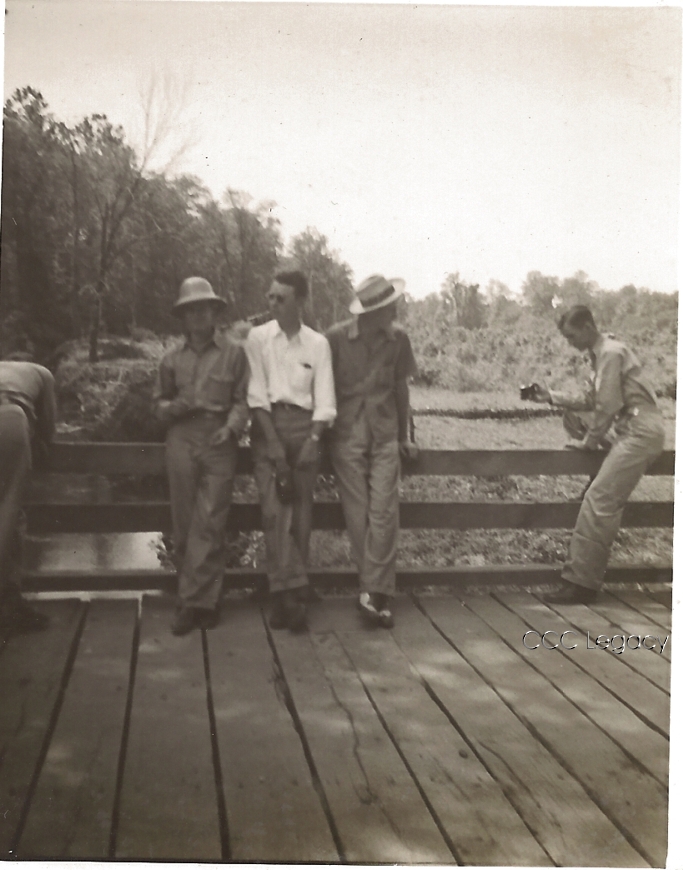
CCC enrollees on a bridge they built in Virginia. The Corps constructed 41,303 bridges and 125,000 miles of roads — infrastructure still in daily use today.
The Land
Reforestation and Fire — Conservation at Scale
The CCC's most visible legacy is reforestation. Three billion trees planted between 1933 and 1942 — estimates range from 2.3 to 3.5 billion — represent more than half of all reforestation done in American history up to that point. On the Great Plains, CCC crews planted 220 million trees in a "shelterbelt" stretching from the Canadian border to the Texas panhandle, dramatically reducing the wind erosion that had created the Dust Bowl.
Forest stands improved: 3.1 million acres. Forest area treated for disease and insects: 17.3 million acres. In parallel, the CCC built the fire protection infrastructure that America's forests still depend on. Three thousand four hundred seventy fire lookout towers — a number so specific it stands as evidence of how precisely the CCC tracked what it built. Ninety-seven thousand miles of fire roads. Six and a half million man-days devoted to firefighting. For nine years, when fires broke out across America's forests, CCC crews were often first on the line.
Parks and Infrastructure
The Backbone of America's Public Lands
Before the CCC, many states had few or no state parks accessible to the public. The CCC changed that — permanently. Seven hundred eleven new state parks were established through CCC work; 800 national and state parks were improved. The labor and infrastructure the CCC provided made state parks viable and accessible for the first time. Today, you cannot visit a major American park without encountering structures the CCC built: trails, roads, picnic pavilions, bath houses, visitor centers, ranger stations, campgrounds, amphitheaters.
The CCC built or improved facilities at Shenandoah National Park — including Skyline Drive. At the Great Smoky Mountains, enrollees built roads, trails, campgrounds, and bridges. At Pickett State Park in Tennessee, the CCC created the entire 20,000-acre park between 1934 and 1942, excavating a 12-acre lake and building every structure on the grounds. At Gooseberry Falls State Park in Minnesota, CCC workers built 80 or more structures, including the "Castle in the Park." At Bastrop State Park in Texas, the iconic stone refectory and cabins built by the CCC remain in daily use.
Many of these CCC structures are now listed on the National Register of Historic Places, recognized for their distinctive "parkitecture" style — native stone and timber construction designed to blend with the landscape and built to outlast generations. They were not built to be temporary. They were built to last.
Beyond parks: 125,000 miles of roads and truck trails. Forty-one thousand three hundred and three bridges. Sixty-six thousand miles of telephone lines laid through wilderness. Four thousand one hundred and five fish-rearing pools. Six thousand two hundred seven miles of streams improved. Six hundred thirty-six million young fish stocked. The full list of what the CCC built is not poetry — it is an inventory. And it runs for pages.
The Men
What the Corps Did for Three Million Men
The CCC's impact on the men who served was as profound as its impact on the land. Fifty-seven thousand illiterate men learned to read and write through camp education programs. Thousands completed high school or took vocational courses. Enrollees gained practical skills — carpentry, masonry, surveying, mechanics, forestry, heavy equipment operation — that translated directly into employment after the program ended. Four hundred fifty thousand enrollees left the program early after finding private-sector jobs. That number is itself a measure of success: the Corps made men employable.
When World War II began, former CCC enrollees proved exceptionally well-prepared for military service. Months or years of outdoor physical labor had built fitness that basic training could not easily replicate. Discipline and teamwork from camp life were already second nature. Practical skills — construction, mechanics, first aid, navigation — were directly applicable in the field. Leadership experience from those who had served as section leaders prepared them for officer roles. The Army noticed. Many veterans and historians have since argued that the CCC was, among its other things, a preparedness program that the nation desperately needed.
Notable CCC alumni include Norman Borlaug — who went on to win the Nobel Peace Prize in 1970 as the father of the Green Revolution, whose agricultural advances are credited with saving over a billion lives. The tree he planted as a CCC enrollee in the early 1930s was not the last tree he would plant.
Notable Alumnus
Norman Borlaug
CCC enrollee, 1930s. Nobel Peace Prize recipient (1970). Father of the Green Revolution — whose agricultural advances saved over a billion lives from famine.
Economic Impact
$663 Million
Sent home to enrollees' families over nine years — the primary income for an estimated 12 to 15 million family members during the Depression.
The Bigger Number
450,000
Enrollees who left the program early after finding private-sector employment — testament to the real, marketable skills the CCC gave them.